
As a young man right out of school and at my first job I had a benefit called a 401k. My employer matched my contributions up to 10% of my salary and the money deposited was pre-tax dollars, it reduced my income tax and my employer contributions appeared to double my contributions giving me an ROI of 100% at the start. I remember thinking this is great, what could go wrong?!
Well then I met my Broker. It was one of those fancy offices with marble floors and leather chairs so soft you could fall asleep in them.
They served coffee and pastries and niceties dripped from their lips. I felt pampered and indulged. Little did I know I was being led like a sheep to the slaughter. My Broker and Brokerage shall remain nameless to protect the guilty because they have a lot of money.
My broker had me invest in a balanced and diversified portfolio of growth stocks, bonds and mutual funds of two types. He explained that diversification was the key to not losing money. What he didn’t tell me was that it was also the key to not making money, the way he did it.
He explained to me, when stocks go down bonds go up, so I should be in both of them. He then also had me invest in two different mutual funds with opposite characteristics. So when one went up, the other went down. It struck me that I didn’t understand what these companies made or produced and why I should invest in their success. It struck that if half my investments went up and the others went down I wouldn’t make any money. Lastly, I wanted to watch my money closely, but following the stocks individually, but I was invested in over two hundred stocks in the mutual funds and the ten individual growth stocks I invested in turned out to be to many stocks to research and follow, while working full time, raising a family, doing extra things at work once in a while and you know “having a life”.
But while I had many questions, my broker was the expert and my coworkers assured me that the big fancy office meant they knew how to make money, so I should relax and trust them. Besides, surely the brokerage didn’t become successful losing its clients money...right?
But then came the losses, the commissions, the fees, and the years my stocks did well and my bonds did poorly, then my bonds did well and my stocks did poorly and my mutual funds, which started out with a negative ROI due to fees and commissions never seemed to get back to the original capitol I invested.
I was in this for the longterm, so I ignored my nagging fears. I trusted them, but started studying the Brokerage business and how they made money. I was hoping to show myself they made money off their clients success. I was in for a disappointment.
The stocks I bought each paid a handsome commission to my broker. I thought I was paying for his expertise until I discovered that his company used multiple newsletters and they were seemingly following someone else’s picks. I called my broker, he reassured me they were sound picks, but didn’t seem to know what they did or why they were going to be successful. The research department knows he always said. Then he called someone, ordered my stock but and charged me $50-$200 for that call! It was the same for bonds.
The mutual funds were worse. There were “load” funds and “no load” funds. The “load funds” charged a percentage of your investment to join. I was always directed to buy load funds. I agreed, he made the calls, I paid the fees. Later I found that for some funds, these fees were split with my broker. You can probably guess by now those fee splitters were what my broker had me buy. When I first found out I was surprised that this was allowed. Surely this fee splitting influenced their decision to have me but those funds. But it was legal.
Then I discovered “fees for order flow”. I don’t know how to explain it, so that doesn’t sound criminal so forgive me. My broker had a choice which exchange to buy my stocks from. The prices were very different at each exchange, sometimes more then a dollar difference. If I bought a thousand shares it could mean a thousand dollar difference. I always assumed my Broker shopped for the best price. That was not true. The exchanges paid my brokerage for the volume of trades. The more trades they made with an exchange the more fees they received. This was clearly a conflict of interest in getting me the best price. But it was legal.
And then I investigated how much it would cost for me to buy these stocks and mutual funds myself. I could do so at a fraction. A fraction of the price they were charging. But then again I was paying for their expertise right?
Ten years into my job I looked at my retirement account and smiled because it had an impressive amount of money in it. But then I calculated my contribution and my gain. There was little or no gain. My balance was mostly due to my contributions and my employers match. My brokers contribution was negative ROI. But my brokers contribution to my education was immense. I learned to read the fine print which explained things like “order for glow” and “few splitting” which were legal because I consented to them when I signed one of those fifty pieces of paper when I opened my account.
You know the deal, you sign paper after paper, each time they give you a copy and you take home a huge holder to “read later” and if your like me that doesn’t happen. You spend time with your family. Ideally the time that things should be explained to you is when your at the brokerage, not when your home spending the few hours a day you have to actually interact with your loved ones. But all your time there is spent signing and then your busy broker is late for another appointment. He picks up another huge folder of papers “that his client needs to sign” and off he goes.
But after ten years, my education was complete. I pulled my money out. Reverse diversified into a few companies I could understand and follow closely. I paid fewer commissions and fees, and always read the fine print. I thank my brokerage for forcing me to learn these things myself.
Later my former Brokerage was taken to court by a coalition of its former customers and the class action lawsuit put my brokerage out of business temporarily until it merged with another Brokerage which also was almost sued out of existence. The small settlement was small, but none the less, a small modicum of justice served.
✍️written by Shortsegments.

Shortsegments is a blogger or writer on the Steemit social media platform, where content producers get paid for posting their content. A big difference between Steemit a decentralized platform like Steemit and centralized platforms like Facebook or YouTube is that there isn’t a central authority or owner to take your account away from you and your account can’t be deleted. You are the owner of your account.
Read other articles by @shortsegments on the Steemit Social Media Platform.
Read shortsegments investment blog on the Steemleo investment Blog
Please follow @shortsegments Twitter Feed Here
Curious? Want to learn more about Steemit??

A very important difference between Steemit and centralized platforms like Facebook, Instagram or YouTube, is that there isn’t a central authority or owner to take your account away from you and your account can’t be deleted. You are the owner of your account. Find out more at this Link
Do you want to join the Steemit Social Networking Platform and don’t know where to start? No Problem there’s Steem Onboarding to help, and the information is available in Six Languages!
Steem Onboarding helps you apply for an account and is a series of videos which explains how Steemit works. You don’t need to understand everything about the blockchain to post content and our Onboarding help is available in six different languages.
Steemit Steem

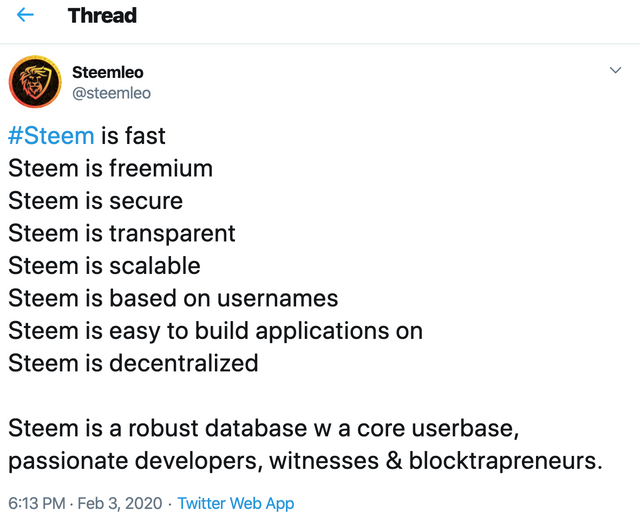
Steemit is a decentralized social media platform on a blockchain called Steem.

Posted via Steemleo